
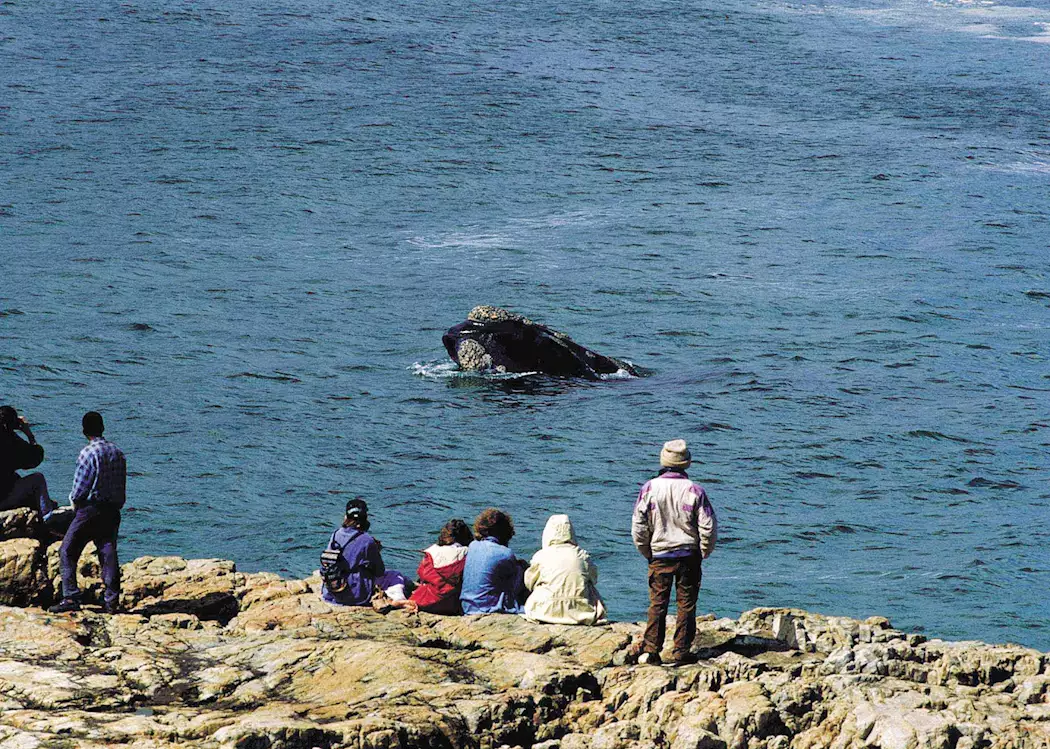
Hermanus, on South Africa’s Whale Coast, is widely regarded as the best land-based whale watching destination in the world. The season runs from June to early December and peaks from August to October, when Southern Right Whales gather in Walker Bay to mate and calve – just 90 minutes (about 120 km) from Cape Town.
This guide covers the season month by month, the whales you’ll see, where and when to watch, what it costs, and how Hermanus compares to Gansbaai – so you can plan the trip with confidence. If you’d rather not drive, see our whale watching tour from Cape Town.
Quick answer
Whale watching season in Hermanus runs from June to early December and peaks from August to October, when Southern Right Whales gather in Walker Bay. September and October are the most reliable months.
The season builds gradually: first arrivals appear in June, numbers climb through July and August, and the bay fills during the September–October peak. By November, most whales begin heading south, with only stragglers by early December. For the best odds, aim for September or October, when whale numbers are highest, and mother-and-calf pairs come closest to shore. Sightings are never guaranteed – nature keeps no timetable and conditions vary daily – so treat any “guaranteed sightings” promise with healthy scepticism.
Month | What to expect | Sighting likelihood |
|---|---|---|
June | Season opens; first arrivals | Building |
July | Numbers are increasing; they vary year to year | Moderate |
August | Calving peak; mothers and calves arrive | High |
September | Often the best month; Hermanus Whale Festival | Very high |
October | Peak mating: the highest whale numbers | Very high |
November | Whales begin heading south | High, tapering |
December | Last of the season; stragglers | Low |
Quick answer
The main species in Hermanus is the Southern Right Whale, seen from June to December. Humpback whales pass earlier in the season, alongside Bryde’s whales, dolphins and Cape fur seals.
Southern Right Whales enter Walker Bay specifically to calve in its sheltered water, which is why they appear so close to shore and so often in mother-and-calf pairs. You can recognise them by their lack of a dorsal fin and the rough white patches on the head, called callosities, which are as individual as a fingerprint. Humpback whales migrate from June to September, usually further out. Beyond the whales, Walker Bay is alive with dolphins, Cape fur seals and seabirds.
Yes. Hermanus offers the best land-based whale watching in the world – Southern Right Whales come within metres of the cliffs, and viewing from the cliff path is free and needs no booking.
This makes Hermanus ideal for families, older travellers and anyone prone to seasickness. For where to stand and how shore viewing compares with a boat trip, read can you see whales from shore in Hermanus?
The best whale watching spots in Hermanus are the Old Harbour and Gearing’s Point on the cliff path, with Sievers Point, Kwaaiwater, Voëlklip and Grotto Beach also offering excellent free viewing over Walker Bay.
The Old Harbour and Gearing’s Point are the historic heart of cliff-path whale watching, with viewing terraces and the Old Harbour Museum. Sievers Point often gets you closest to whales from land, while Kwaaiwater, Voëlklip and Grotto Beach give wide, uncrowded views across the bay.
Quick answer
The best time of day for whale watching in Hermanus is early morning, when the sea is calmest and visibility is clearest, before the afternoon south-easter picks up.
Calm water makes a blow or fin far easier to spot, and morning light reduces glare for photography. For a full morning-vs-afternoon breakdown, see the best time of day for whale watching.
There are four ways to see the whales, each suited to a different budget and comfort level. Boat-based whale watching is strictly regulated: only licensed operators may run dedicated trips, and boats must keep a respectful distance.
Tour type | What it’s like | Typical cost (2026) | Best for |
|---|---|---|---|
Land-based (cliff path) | Self-guided viewing from the rocks above Walker Bay | Free | Families, budget, flexible timing |
Boat-based | Licensed ~2-hour trip from the New Harbour, guide on board | ~R900–R1,300+ per adult | Close encounters and commentary |
Aerial (Cessna / helicopter) | Bird’s-eye view of mothers and calves | Premium | Photographers, special occasions |
Sea kayak | Guided paddle along the coastline | Mid-range | Active, adventurous travellers |
Quick answer
Boat-based whale watching in Hermanus typically costs around R900–R1,300 per adult in 2026, with reduced child rates. Land-based cliff viewing is free; aerial flights cost considerably more.
Experience | Typical price (2026) | Notes |
|---|---|---|
Land-based (cliff path) | Free | No booking needed |
Shared boat tour | ~R900–R1,300 per adult | Child rates usually about half |
Private boat charter | Higher | Smaller group, more flexibility |
Helicopter / Cessna flight | Premium | Best for photography |
Choose Hermanus for world-famous, free land-based cliff viewing and easy Cape Town access; choose Gansbaai for boat-based marine adventure and nearby shark cage diving.
Factor | Hermanus | Gansbaai |
|---|---|---|
From Cape Town | ~90 min (closer) | ~2+ hours (further) |
Signature experience | Land-based cliff-path viewing | Boat-based marine adventure |
Famous for | Whale Crier, Old Harbour, cliff path | Shark cage diving, Dyer Island |
Best for | Easy access, free viewing, dining and wine | Combining whales with sharks and seals |
Hermanus is located approximately 90 minutes from Cape Town (around 120 km), making it one of the easiest and most rewarding day trips from the city. You can reach Hermanus via either the scenic R44 coastal route or the faster N2 highway, depending on whether you prioritize views or speed.
The drive is part of the appeal. The R44 along Clarence Drive is one of South Africa’s most beautiful roads, and you can often spot whales from the roadside lookouts before you reach Hermanus. If you don’t have a car – or would rather relax and leave the driving, timing and planning to a local guide – a guided whale watching tour from Cape Town is the easiest way to experience the Whale Coast.
The season runs from June to early December and peaks from August to October. September and October are the most reliable months, when Southern Right Whales are most abundant in Walker Bay.
Yes. Hermanus offers the best land-based whale watching in the world. Whales come close to the cliffs, and viewing from the Old Harbour cliff path is free and needs no booking.
Early morning is best, when the sea is calmest and visibility is clearest, before the afternoon wind picks up.
During the August–October peak and the September Whale Festival, yes – boat tours fill days ahead. Land-based viewing never needs a booking.
In peak season, dozens of Southern Right Whales gather in Walker Bay, and it’s common to see several – often mothers with calves – on one outing. Daily numbers vary with the weather.
Mainly Southern Right Whales from June to December, recognisable by their callosities and lack of a dorsal fin. Humpback whales pass earlier, alongside dolphins and seals.
Yes. Hermanus ranks among the world’s top whale watching destinations, with reliable peak-season sightings, free cliff-top viewing, an easy trip from Cape Town and excellent food and wine.
Very. The cliff path is free, safe and stroller-friendly, and boat operators offer discounted child rates.
Whale season is short and the best months book out fast. Let Zion Escape Tours plan your day on the Cape Whale Coast. Book a whale watching tour from Cape Town.
Zion Escape Tours is a Cape Town-based tour operator specializing in private and group tours across Cape Town and its surrounding destinations. We create personalized travel experiences tailored to your interests, combining local expertise, exceptional service, and carefully crafted itineraries to help you explore the very best of the Mother City.
+27 61 354 6457
© 2026 Zion Escape Tours. All Rights Reserved. Website Designed By Kijo Digital